
Why Everyone Should Learn Robotics
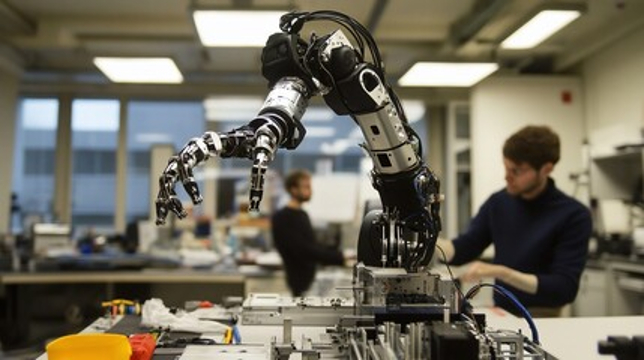
Forget the hype. Robotics isn’t about humanoids or sci-fi futures. It’s a discipline grounded in mathematics, physics, software, and hardware. Tools used to solve real problems.
At its core, robotics is about building systems that sense the world, make decisions, and act with purpose. Anyone can learn the fundamentals. The key is to start building.
How Robots Actually Work
A robot is a closed loop: it takes in information, makes decisions, and moves. The form doesn’t matter. It could be a self-driving car, a surgical arm, a drone or a mobile rover.
Every robot depends on three core elements:
-
Sensors to read the environment
-
Systems to interpret those readings
-
Motors or actuators to perform actions
All of it runs on logic written by people. From autonomous drones to household vacuums, robotics is a product of design, not magic.
Engineering, Not Illusion
Every robot begins with a design question. What needs to be sensed? How should it respond? What hardware fits the task?
Even a line-following robot must integrate vision, control, and feedback. That same pattern appears in industrial arms, planetary rovers, and AI-powered agents.
This is engineering work. It requires precision, iteration, and understanding. Not flash.
Why Robotics Is Worth Learning
Robots are now part of daily life. They move goods through warehouses, support surgeons in hospitals, inspect infrastructure, and explore terrain that humans can’t.
Learning how they work is no longer optional. It’s technical leverage. It’s also a question of equity. As robotics becomes central to agriculture, manufacturing, energy, and defense, knowing how to shape these systems matters.
The choice isn’t whether robots will exist. It’s who understands them well enough to shape the future.
The AI Shift in Robotics
Artificial intelligence is transforming how robots learn and operate. Instead of hand-coding every decision, engineers now teach robots through demonstration, simulation, and data. Techniques like imitation learning and reinforcement learning make it possible to show a robot what to do, rather than spell it out line by line.
This shift expands what’s possible. Automation is no longer limited to high-volume, repetitive tasks like factory assembly. Robots can now adapt to complex, low-volume environments from hospital logistics to precision agriculture. And with that comes a shift in required skills. Engineers need to understand perception, training pipelines, and real-world deployment, not just control loops.
This is a new kind of robotics, its faster to build, more adaptive, and open to more builders than ever before. The skills required are incredibly diverse, including software engineering, design, mechanical engineering, physics, embedded systems, and machine learning.
Where to Start
You don’t need a formal lab or a fancy resume to begin. You need a problem you care about and a willingness to build, physically in the real world, not simulation.
Get your hands on something real. Work with a Raspberry Pi or Arduino. Explore ROS2. Join an open-source project and a robotics club. Watch how code becomes motion.
This is important: expect friction. Robotics is hard, there is a lot of debugging and dead ends. Software sometimes doesn’t work the way you expect, same with hardware. That’s where learning happens, building resilience and actually becoming a roboticist.
What You’ll Actually Learn
Robotics teaches more than mechanics. It builds skills in debugging, communication, systems thinking, and persistence.
Every project includes missteps. A motor doesn’t respond. A sensor is offline. An AI model fails. You’ll chase down edge cases, rethink designs, and test fixes until the system holds.
That process creates engineers who can adapt, troubleshoot, and lead.
The Bigger Picture
Across Portland and beyond, builders are already shaping robotics from the ground up. We’ve seen students take weekend kits and create SLAM-capable machines. We’ve watched career engineers pivot from web development to robotics with hands-on fluency.
These aren’t isolated wins. They’re signals. The tools are accessible. The projects are real. The stakes are high.
Your Invitation
Robotics doesn’t require perfection. It rewards practice. If you’re curious, now is the time to start. Open a GitHub repo. Join a club. Write your first script. Build something that moves.
The future of robotics will be shaped by those who choose to engage early, learn deliberately, and build with purpose.