
Rose City Robotics Wins the DOE Lithium-Ion Battery Recycling Prize Breakthrough Contest
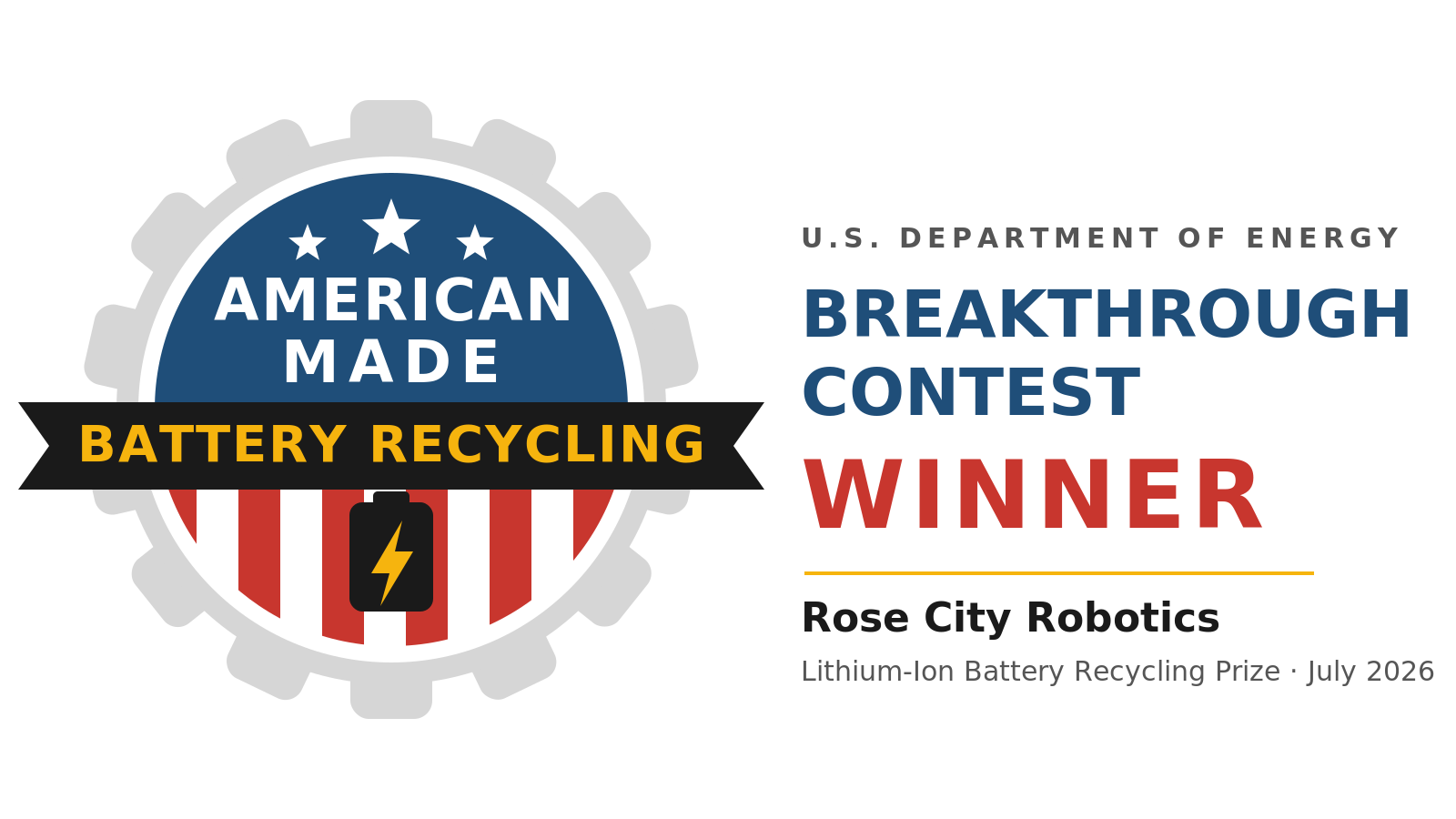
We have some big news to share: the U.S. Department of Energy’s Office of Critical Minerals and Energy Innovation has named Rose City Robotics a winner of the Lithium-Ion Battery Recycling Prize Breakthrough Contest. We’re one of eight winning teams nationwide — and one of five in Track 1 for new competitors — receiving a $200,000 award and advancing to Phase IV of the competition.
“This contest showcases the ingenuity required to maximize the value and useful life of critical materials,” said Assistant Secretary of Energy Audrey Robertson in the DOE’s announcement. We’re honored to be part of that group, alongside teams like ReJoule, BinIt, NAECO, Glimpse Engineering, Li Industries, Renewance, and Smartville.
Why this prize exists
Launched in 2019, the Lithium-Ion Battery Recycling Prize was designed to increase the recovery rates of critical materials from lithium-based batteries in the United States, so those materials stay in the domestic supply chain instead of leaving it. The Breakthrough Contest challenged teams to accelerate the infrastructure needed to collect, sort, transport, and process spent lithium-ion batteries — with a target of pushing recovery rates above 90%.
We are so proud and honored by the perseverance of the grant and prize administration team at Argonne National Labs and the U.S. Department of Energy. Even though we have had to wait a full two years since submitting our application in August 2024, this capital is essential in enabling entrepreneurs and small businesses, the lifeblood of the American economy, to continue to develop innovation in the Lithium Ion battery recycling industry.
Our application: robots that learn disassembly from experts
Our winning submission, Autonomous Robotic Lithium-Ion Battery Disassembly, Testing and Processing, proposes a third path: disassemble first, with robots.
The system is built on imitation learning — the Action Chunking with Transformers approach pioneered at Stanford with the ALOHA robot. An expert technician disassembles a pack via teleoperation while the battery sits in an isolated, nitrogen-blanketed cell. The human never gets near the hazard. Every teardown becomes training data, and over time the robot runs autonomously, with a technician taking over only when something novel comes up. Each intervention makes the system smarter.
Disassembly changes the economics of recycling. End-of-life EV batteries typically still hold about 80% of their capacity, so packs come apart into modules, cells, and components that can be sorted for second-life applications like stationary storage. What can’t be reused ships to recyclers without the structural material and packaging — lower transport cost per pound of critical material, cleaner feedstock, fewer chemical inputs, and higher recovery of the metals that matter.
We built this application with partners across the battery value chain: Oak Ridge National Laboratory (our evaluation partner), Cirba Solutions, American Battery Technologies, Ecobat, Daimler Trucks NA, Orange EV, Navistar, Lico Materials, Polaris Battery Labs, Loupe Robotics, and Portland State University. Thank you to every one of them — and to the DOE teams behind the prize.
What happens in Phase IV
In Phase IV, in addition to $200,000 cash, each advancing team receives $100,000 in noncash vouchers to support validation, evaluation, and techno-economic and life cycle analysis of their proposals. The phase culminates in a $1 million grand prize for the overall winner, with up to $3 million distributed among up to four runner-up teams.
For us, that means scaling our prototype from e-bike battery packs to full EV packs, working with Oak Ridge National Laboratory to evaluate the system on a Nissan Leaf battery. There’s a lot of engineering between here and there, and we can’t wait to get started.
If you work on battery end-of-life — as a recycler, an OEM, a researcher, or a policymaker — we’d love to talk. Reach us at hello@rosecityrobotics.com.
The U.S. Department of Energy’s (DOE’s) American-Made Lithium-Ion Battery Recycling Prize is designed to incentivize American entrepreneurs to develop and demonstrate processes that, when scaled, have the potential to advance DOE’s goals to support domestic critical mineral and material supply chains by building a recycling ecosystem and developing alternatives to reduce material reliance. The prize aims to help meet the growing demand for lithium-ion batteries in a variety of applications, including consumer electronics, stationary, and transportation. It was developed by DOE’s Office of Critical Minerals and Energy Innovation (CMEI) and is administered by DOE’s National Laboratory of the Rockies (NLR) as part of DOE’s American-Made Challenges program. To learn more, visit: batteryrecyclingprize.org.